Cooperative board games for families: win together or lose together
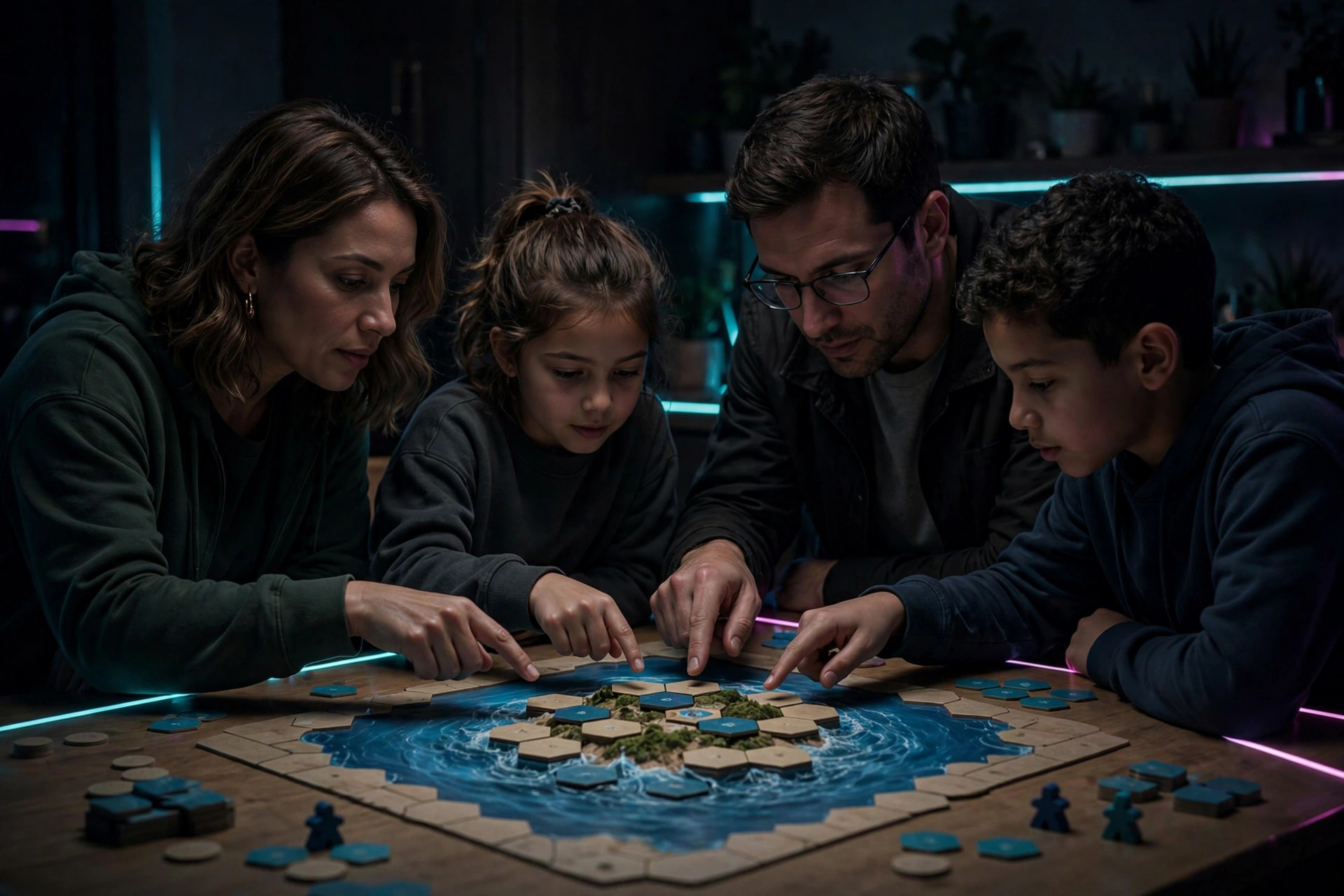
Some game nights end with a champion. Others end with someone crying into a couch cushion because an older sibling took the last property, the last resource, or the last point. Cooperative games remove the cushion from the equation. In a cooperative game, as the definition quoted by Simple Homeschool puts it, everyone plays together, no one is left out, and players work as a team against a common obstacle rather than against each other, the emphasis is on play, not competition. The opponent is the game itself: a rising sun, an escaping fox, a sinking island, a castle under siege, an outbreak, a sunken continent. Your family either beats it together or loses to it together, and losing to a cardboard island turns out to be much easier to laugh about than losing to Dad.
The catch is picking the right one. Most recommendation lists rank cooperative games by quality and stop there, which quietly assumes your table looks like every other table. It does not. A game that thrills a twelve-year-old will strand a four-year-old, and a game gentle enough for a preschooler can bore a ten-year-old into checking out. So this guide sorts six verified games into a ladder by the age of your youngest player, because that is the player who decides whether the night works, and then tackles the two things the ranked lists skip: the one player who tries to run everyone's turn, and which of these games can get harder as your kids grow.
The by-age ladder at a glance
| Game | Youngest player | Players | Time | Reading needed | Difficulty dial |
|---|---|---|---|---|---|
| Hoot Owl Hoot! | 4+ | 2 to 4 | 15 min | None | Add owls, up to 6 |
| Outfoxed! | 5+ | 2 to 4 | 15 to 30 min | None to light | Limited, luck-based pace |
| Castle Panic (2nd ed.) | 8+ | 1 to 6 | 45 min | Card text, shared | Fixed in the base game |
| Pandemic | 8+ | 2 to 4 | 45 min | Card text, shared | More Epidemic cards |
| Forbidden Island | 10+ | 2 to 4 | 30 min | Card text, shared | Starting water level |
| The Crew: Mission Deep Sea | 10+ | 3 to 5 | 20 min | Task cards, shared | Mission progression |
Every player count, age, and time in that table comes from a publisher or retailer specification checked on October 17, 2026, the verification matters, because cooperative games live or die on whether the youngest player can actually take a turn.
Ages 4 to 6: no reading, shared cheering
Hoot Owl Hoot! (Peaceable Kingdom) is the ladder's first rung for a reason: a complete game takes about 15 minutes and no reading is required. Players work together to fly all the owls back to their nest before the sun rises. On a turn, a player plays a color card and moves any owl to the next open space of that color, there is no "my owl" and "your owl," which is exactly the point for this age. Draw a sun card instead and the sun token advances one step toward sunrise. The box holds 6 owl tokens, 1 sun token, 14 sun cards, and 36 color cards, and the difficulty dial is built into that contents list: start with three owls for an easy win, and add owls, up to all six, as the table gets better. A four-year-old's contribution is real (pick a card, move an owl, make the hooting sound when an owl flies over another owl), and the shared enemy is a sunrise, which nobody has to feel guilty about racing.
Ages 5 to 8: first deduction
Outfoxed! (Gamewright) is a cooperative whodunit for 2 to 4 players, rated 5+, and it gives young players their first taste of actual reasoning. Mrs Plumpert's prized pot pie has gone missing, and the team moves detective pawns around the board gathering clues, then feeds those clues into a special evidence scanner to rule out suspects, while the guilty fox inches toward the exit. The components do the teaching: 16 suspect cards, 16 thief cards, 12 clue markers, 4 detective pawns, 3 custom dice, a fox figurine, and the scanner itself. Because suspects are eliminated by evidence rather than by argument, a six-year-old's "it can't be that one, he has no hat" is a genuine deduction, not a guess an adult has to pretend to value. One caution for this band: the fox's escape is a real loss condition, and it arrives fast. That is a feature. A short, shared, slightly unfair-feeling loss to a fox is the safest possible rehearsal for losing at all.
Ages 8 and up: real strategy, shared stakes
Castle Panic, in its second edition from Fireside Games, seats 1 to 6 players aged 8+ and runs about 45 minutes. The team defends a castle at the center of the board from monsters advancing out of the surrounding forest, trading cards and planning together to keep the towers standing. It is the ladder's pick for bigger or mixed-age groups, because six seats is generous and a younger player can be handed the satisfying jobs. One wrinkle worth naming before you buy: the team wins or loses together, but the player with the most victory points is declared the Master Slayer. Some families love that second, gentler contest; families escaping a too-competitive table may want to simply not announce it. Price check, October 17, 2026: the second edition was listed at CA$44.99 at Arctic Board Games and shown out of stock on that date.
Pandemic (Z-Man Games) is the heaviest game on the ladder that still belongs on a family shelf: 2 to 4 players, ages 8+, about 45 minutes. Each player takes the role of a disease-fighting specialist with a unique skill, and the team races to cure four diseases while outbreaks keep lighting fires elsewhere on the map. A cure normally costs five cards of one disease's color discarded at a research station, the Scientist needs only four, which is the kind of asymmetry that makes role assignment a real family conversation. Epidemic cards are the engine of dread: one infects a brand-new city with three cubes and raises the infection rate for the rest of the game. Its difficulty dial is the number of Epidemic cards shuffled in, so the same box that a family beats on its first try can be made properly frightening a year later.
Forbidden Island (Gamewright), designed by Matt Leacock, runs a tight 30 minutes for 2 to 4 players aged 10+. The team of adventurers, explorer, pilot, engineer, diver, messenger, navigator, each with a special ability, must capture four sacred treasures from an island of 24 tiles and escape before the whole thing sinks into the ocean. The box contents tell the story: 58 playing cards, 24 island tiles, 6 pawns, and 4 treasure figurines. Difficulty scales with the starting water level, so a first game can begin gentle and later games can start with the water already rising. And The Crew: Mission Deep Sea (Kosmos) closes the ladder: a cooperative trick-taking game for 3 to 5 players, ages 10+, about 20 minutes a mission, in which the crew dives in search of the lost continent of Mu. Communication between crew members is severely limited by design, and winning means winning the right tricks in the right order. Price check, October 17, 2026: CA$19.99 at Arctic Board Games, listed in stock that day, the cheapest entry on this ladder, and, as the next section explains, the most instructive.
The quarterback problem, and the fix
Every cooperative game has the same failure mode, and it is not the game. It is the most confident person at the table, often a parent, narrating the optimal move on every turn until everyone else is just pushing pieces where they are told. The game is still cooperative on paper. In practice it has become one person's solo game with an audience, and kids disengage from it exactly the way they disengage from being lectured. Ranked lists never mention this, which is odd, because it decides whether a cooperative game gets played twice.
Use this decision framework. If the quarterbacking comes from enthusiasm (a parent who sees the good move and cannot hold it in), fix it with procedure, below. If it comes from the game, open hands, perfect information, one obviously correct play, fix it with selection: limited-communication designs like The Crew make quarterbacking structurally impossible, because no single player can see enough to direct anyone. And if the youngest players are the ones being directed, drop down the ladder: in Hoot Owl Hoot! there is rarely one correct owl to move, so there is little to quarterback.
- Cards face up, voices in turn order. Shared information is already the norm in most of these games; make the discussion match it. The player whose turn it is speaks first and decides last.
- Advice costs a sentence. Anyone may suggest a move, but only as one sentence, once, and then they stop. "If you shore up that tile, the treasure tile survives" is advice. A second sentence is a takeover.
- Rotate the final call. On genuinely shared decisions, which treasure to chase, which city to treat, the final call rotates around the table regardless of whose turn it is.
- Let a bad move stand once a game. If the table overrules every sub-optimal play, younger players learn their job is to wait for instructions. One cheerfully allowed mistake per game teaches more than a flawless adult-run win.
- Debrief the loss together. When the team loses, name one thing the team will try next time. The game beat everyone; the fix belongs to everyone too.
What success looks like: by the second game, the youngest player makes at least one decision per round that nobody corrects, the most experienced player gives at most one-sentence advice, and a loss produces an argument about what the team should try next, not silence, and not one person explaining what everyone should have done.
Difficulty dials that grow with your kids
The cheapest cooperative game is the one you do not have to replace next year, so the dial column in the table is worth a second look. Hoot Owl Hoot! scales by owl count. Pandemic scales by Epidemic count. Forbidden Island scales by starting water level. The Crew scales by mission progression, the search for Mu is a sequence, so the game literally deepens as the crew improves. Castle Panic's base game, by contrast, plays at one fixed pressure, which is part of why it suits a stable mixed-age group rather than a fast-growing one. None of this requires buying expansions; each dial is printed in the box you already own. When you shop, ask one question the ranked lists do not: how does this game get harder? If the honest answer is "it doesn't," budget for it as a one-stage game and enjoy it for exactly that stage.
FAQ
What is the best first cooperative game for a 5-year-old? Hoot Owl Hoot! if the child is closer to 4 to 5 and not reading yet; Outfoxed! if they are a confident 5 and ready to reason out loud. Both finish in about 15 to 30 minutes, so a loss never has time to turn into a saga.
Are cooperative games good for a child who hates losing? They are the standard remedy, with a caveat: the child still loses, to the island, the sun, or the fox, but nobody at the table beat them, and the whole family shares the loss. Start with a dial turned down (three owls, fewer Epidemics) so early games end in wins while the habit forms.
How do you stop one person controlling a cooperative game? Rotate the final call, shrink advice to one sentence, and let one imperfect move stand each game. If the directing persists, switch to a limited-communication game such as The Crew: Mission Deep Sea, where the design itself prevents any one player from running the table.