Two-player games for parent and kid on busy nights
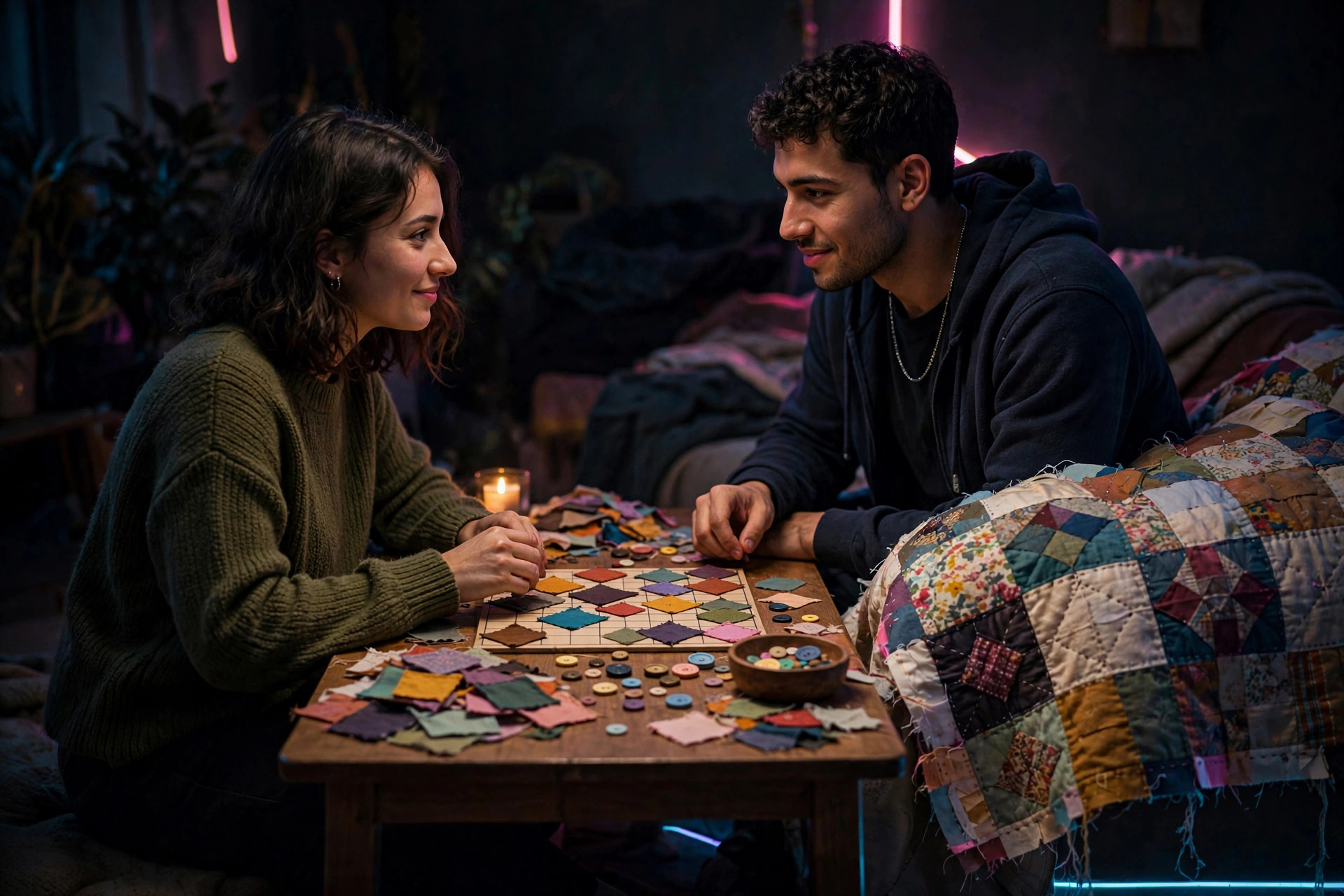
Most weeknights, family game night is not a crowd. It is one parent, one kid, a cleared corner of the dinner table, and maybe half an hour before bedtime asserts itself. That pairing has its own rules, and the big recommendation lists mostly ignore them: search for two-player games and you get video-game couch co-op on one side, date-night lists on the other, and kids' lists that assume an adult is only supervising. A parent-and-kid game has to clear a specific bar. It must teach in minutes, because ten minutes of rules eats half the evening. It must finish, a game abandoned at the halfway point teaches the wrong lesson about starting. And it has to handle the built-in skill gap honestly, because a parent who wins every night is not a playmate, and a parent who visibly throws every game is not one either.
Two things decide whether a two-player game survives contact with a tired Tuesday: how long it takes to teach, and what losing feels like. The second matters more than parents expect, and it is mostly determined by interaction style. In a parallel puzzle, each player builds their own thing and the scores are compared at the end, nobody reaches across and wrecks the child's work. In a direct duel, every good move is a small injury to the other player. In a cooperative pair game, there is no loser across the table at all. The five games below are compared on exactly those terms, with every player count, age, and time verified against publisher or retailer listings on October 17, 2026.
The five picks at a glance
| Game | Ages | Time | Interaction style | Teach time | Best when the kid is… |
|---|---|---|---|---|---|
| Patchwork | 8+ | 15 to 30 min | Parallel puzzle | About 3 min | Younger, or hates direct conflict |
| Hive | 9+ | About 20 min | Direct duel, no luck | About 4 min | A thinker who wants a fair fight |
| Jaipur | 10+ | 30 min | Direct duel with luck | About 3 min | Ready to read a market and race |
| 7 Wonders Duel | 10+ | 30 min | Direct duel, deepest | About 8 min | Older, wants a real civilization race |
| Codenames Duet | 11+ | 15 min | Cooperative | About 2 min | A word kid, or either of you is a sore loser tonight |
Gentle puzzles: Patchwork and Hive
Patchwork (Lookout Games, designed by Uwe Rosenberg) is the kindest competitive game on this list. Two players, ages 8+, 15 to 30 minutes. Each player fills a personal 9×9 quilt board with odd-shaped fabric patches bought from a shared market, and the game's whole tension is economic: buttons are both the currency you spend and the points you win with, every patch also costs time on a shared time track, and every square left empty at the end costs 2 points. A review at CoopBoardGames calls it a quiet theme hiding sharp, satisfying gameplay, and for a parent-kid table the sharpest part is what is missing, there is no way to attack the other player's quilt. A child can lose and point, accurately, at their own half-finished corner rather than at something a parent did to them. The race is against your own board. For a first two-player purchase for an 8- or 9-year-old, start here.
Hive (Gen42 Games, designed by John Yianni) is the opposite energy in the same small footprint: a pure duel with no luck at all. Two players, ages 9+, about 20 minutes, and no board. The game is 22 insect tiles, 11 per player: 1 Queen Bee, 2 Beetles, 3 Grasshoppers, 3 Soldier Ants, and 2 Spiders, each moving a different way, placed and slid on any flat surface, a kitchen table, a café table, a tray. The goal is to surround the opponent's Queen Bee on all six sides while protecting your own. Because there are no dice and no cards, a loss has nowhere to hide, which is precisely why Hive belongs a rung above Patchwork: give it to the kid who has started saying "you got lucky" and is ready to find out what a completely fair loss feels like. It also packs down to almost nothing, which makes it the one game on this list that can live in a coat pocket or a glove box and turn a wait into a match.
Head-to-head tension: Jaipur and 7 Wonders Duel
Jaipur (Space Cowboys) puts two traders in a market race: 2 players, ages 10+, 30 minutes. On your turn you either take cards, all the camels in the market, one goods card, or a swap of two to five cards, or you sell one type of good. Selling three, four, or five cards at once earns a bonus token, so the game's heartbeat is a single delicious question: sell now for the good tokens, or hold out for the bonus and risk your opponent beating you to the market and draining the values first. Camels, which can never be sold, are the engine of the big swap, and the camel herd is worth a small bonus at the round's end. The richest trader each round takes a Seal of Excellence; the first player to two seals wins the game. That best-of structure is a gift on a school night, a lost round is a chapter, not the story, and the rematch is built into the box.
7 Wonders Duel (Repos Production) is the deepest game here and the one to save for an older kid who wants to feel like they are playing a "real" strategy game: 2 players, ages 10+, 30 minutes. Across three ages, players draft cards from a display of face-up and face-down cards, a card can only be taken once it is uncovered, so every pick is also a decision about what to reveal to your opponent. A taken card can be built, discarded for coins, or tucked under one of your wonders; each player starts with four wonder cards, but only seven of the eight wonders in play can ever be built, so one player finishes the game a wonder short. What makes parents and teens both lean in is that the score is never the only way the game can end: push the military marker into your opponent's capital and you win on the spot, or collect all six different scientific symbols and win just as suddenly. Price check, October 17, 2026: CA$30.95 at Board Game Bliss, listed in stock that day, where the listing showed a 4.93 out of 5 rating from 28 reviews. Teach it on a weekend the first time; after that, it genuinely fits a weeknight.
On the same team: Codenames Duet
Codenames Duet (Czech Games Edition) is the cooperative option, and the publisher's own page is specific about the shape of it: 2 or more players, ages 11+, about 15 minutes. Twenty-five word cards go down in a 5×5 grid. Between the two players sits a double-sided key card; each side shows that player 9 agents to find and 3 assassins to avoid. Partners take turns giving one-word clues with a number, trying to contact all 15 agents between them before the turns run out, the game is played over 9 turns, and the publisher notes you can raise that to 11 while players are learning. Guess a bystander and the turn ends; guess an assassin and the mission fails immediately. For a parent and a word-loving kid, this is the rare game where the adult's bigger vocabulary is an asset the team shares rather than a weapon used against the child, and on the nights when somebody has already lost enough (a test, a game, an argument), it is the pick that ends the evening with both of you on the same side of the table.
The zero-cost deck
No box is required to have a two-player night. One standard deck of cards covers the whole interaction spectrum: War and Speed for fast hands and zero thinking, Gin Rummy and Cribbage when the kid is ready for planning and memory. Keep the deck in the kitchen drawer, not the game shelf, the entire point of the busy-night format is that starting takes less than a minute. If a boxed game is coming later, let the deck be the trial: a child who asks for a Gin Rummy rematch three nights running is telling you exactly which kind of thinker they are, and that is the child Jaipur was made for.
The 30-minute busy-night procedure
- Minutes 0 to 2, clear and choose. Clear plates, not the whole kitchen. Offer two games from the table above, not the whole shelf; the kid picks. Choice is the fastest buy-in there is.
- Minutes 2 to 5, teach by playing. Explain only the first turn, then take one open practice turn together. Every game on this list except 7 Wonders Duel teaches inside five minutes this way.
- Minutes 5 to 25, play one full game. One game, played to its real end. Do not start a second if the clock says there is not time to finish it.
- Minutes 25 to 28, the rematch ritual. Winner chooses the snack or the first player next time; the next session gets named out loud ("Thursday, after dinner"). The game goes back in its box now, while the ending is still good.
- Minutes 28 to 30, hard stop. Bedtime routine starts on time. The hard stop is what makes the next invitation credible, a kid who trusts the end time stops defending against the night and starts enjoying it.
What success looks like: the box is back on the shelf by the time the bedtime routine begins, the loser asks for a rematch on a named night instead of arguing about this one, and starting took less time than clearing the table did. If setup and teaching are still eating half the slot after two tries, drop one rung, from Duel to Jaipur, or from Hive to Patchwork, rather than abandoning the format.
Pick by mood, not by habit
The decision framework is three questions. How much fight is in the kid tonight? None. Codenames Duet. A friendly amount. Patchwork, where the fight is against your own quilt. All of it. Hive or Jaipur. How much brain do you have left? A parent running on fumes should not teach 7 Wonders Duel at 7:40 p.m.; Patchwork and Duet play kindly on low batteries. Is this a first game or a rematch? Rematches can carry more rules than first games, because half the teaching is already done, which is why the same game three Thursdays running beats a new box every week. Rotate only when the current game stops producing the sentence every parent wants to hear at minute twenty-five: "One more, on Thursday?"
FAQ
What is a good two-player game to play with a child under 10? Patchwork, from age 8: no attacks, a puzzle each player solves on their own board, and a 15 to 30 minute length that fits a school night. Under 8, use the standard deck. War needs no teaching at all.
How do you keep a two-player game fair when the parent is better? Change the game before you change your play. Parallel puzzles (Patchwork) and luck-carrying duels (Jaipur) narrow the gap by design; in Hive, the stronger player can spot the weaker one the first move and a head start on surrounding. Deliberately playing badly is the one fix that never works for long, kids detect it, and it insults exactly the opponent you are trying to build.
Is there a cooperative game for exactly two players? Yes. Codenames Duet, for ages 11+, about 15 minutes, in which partners share one mission and split one key card between them. It is the only fully cooperative entry on this list, and the right closer for a night when one more competition is one too many.